Edward George (Ned) Sherrin was born into a farming family at Low Ham in the Somerset Levels, Sherrin attended Sexey's School, in Bruton, Somerset. Although he read law at Exeter College, Oxford and subsequently qualified as a barrister, he became involved in theatre at Oxford and joined British television at the founding of independent television in 1956, producing shows for ATV.
Ned was an openly gay man, he was a patron of the London Gay Symphony Orchestra. Sherrin was awarded a CBE in the 1997 New Year’s honours list. He died of complications of throat cancer on 1 October 2007 aged 76.
Ned on LGBT History Month Web page.
http://lgbthmuk.blogspot.com/2007/10/ned-sherrin-dies.html
Ned on wikipedia
http://en.wikipedia.org/wiki/Ned_Sherrin
Ned on GALHA
http://www.galha.org/glh/251/sherrin.html
Wednesday, 3 October 2007


LGB/T Heritage matters.
“Whatever our alignment and affiliations history is always a useful tool to have when defining ourselves in the world...the denial of history has always been to some extent part of the oppression or marginalisation of groups and the reclaiming or rewriting of history has always been part of their liberation or self-realisation."
Culture wars
Without the earlier subculture of queer politics, gay and lesbian and feminist activists who in the early stages of feminist and sexual politics, built their own networks and communities there would be little to say about LGBT culture.
It was these networks, which were able to respond to the catastrophe of AIDS. With grassroots self help projects, safer sex campaigns, lobbying and fund raising, when HIV/AIDS struck the United kingdom and the western male gay community-to the early indifference of much of the wider society.
There are now more sexual identities and subcultures visible and active in public culture, it is important to remember that alongside popular fascination with gender and sexual diversity, challenges to conservative traditions remain vigorously policed and punished. From epidemic hate crimes against LGB and T people to media fears of the consequences of women’s greater sexual autonomy, and family values which uphold the heterosexual norm.
How is it best to view the culture wars? The apparent rigidity of gender symbolism of the ‘sex act’ remains one of the key factors which can rob women of their personal sexual freedom to choose an identity and autonomy, while at the same time continuing to confirm men’s sexual conformity to masculinity.
Contemporary culture over the last one hundred years has been accompanied by ever greater social acceptance of diversity although this is still seen through the tradition of masculinity and femininity. There has been an expansion in mainstream culture and the promotion of choice as the overriding route to happiness, (in women’s magazines, advice columns, contemporary fiction, film and television). The battle is still open. Funding has been reduced or removed from gay community groups, LGB and T helplines are closing down due to lack of funding, often found previously from health authorities even through HIV infection continues to rise.
Histories
There is a national attempt to recover and rewrite history. The political declaration of an LGB and T identity requires authenticity through reclaiming one’s history.
The Heritage industry seems to create only one version of a twentieth century identity. Putting Lesbian, gay, bisexual and transgender histories at the centre of ‘our’ representation of history we seek to speak for a history and culture which is specific.
We may choose to offer a shared history of our cultural identities which have been and continue to be reflected in a common historical experience and shared cultural codes. (Dress, language, attitudes, etc) which offer us a meaning and identity.
Heterosexuality has been able to, by merely holding back a people’s past, keep a grip on its power and normality. It turns to the past and distorts, disfigures and destroys references to a heritage that goes back millennia. Cultural identity belongs as much to the past as it does to the future; it is a matter of becoming as well as being. We can use this as a step to understanding how ‘we’ have experienced repression and normalization in a heterosexist cultural backdrop.
In order to challenge hostile claims that homosexuality is abnormal or immoral historical experiences of similarities show that being LGB or T is a ‘given’ and has roots in history.
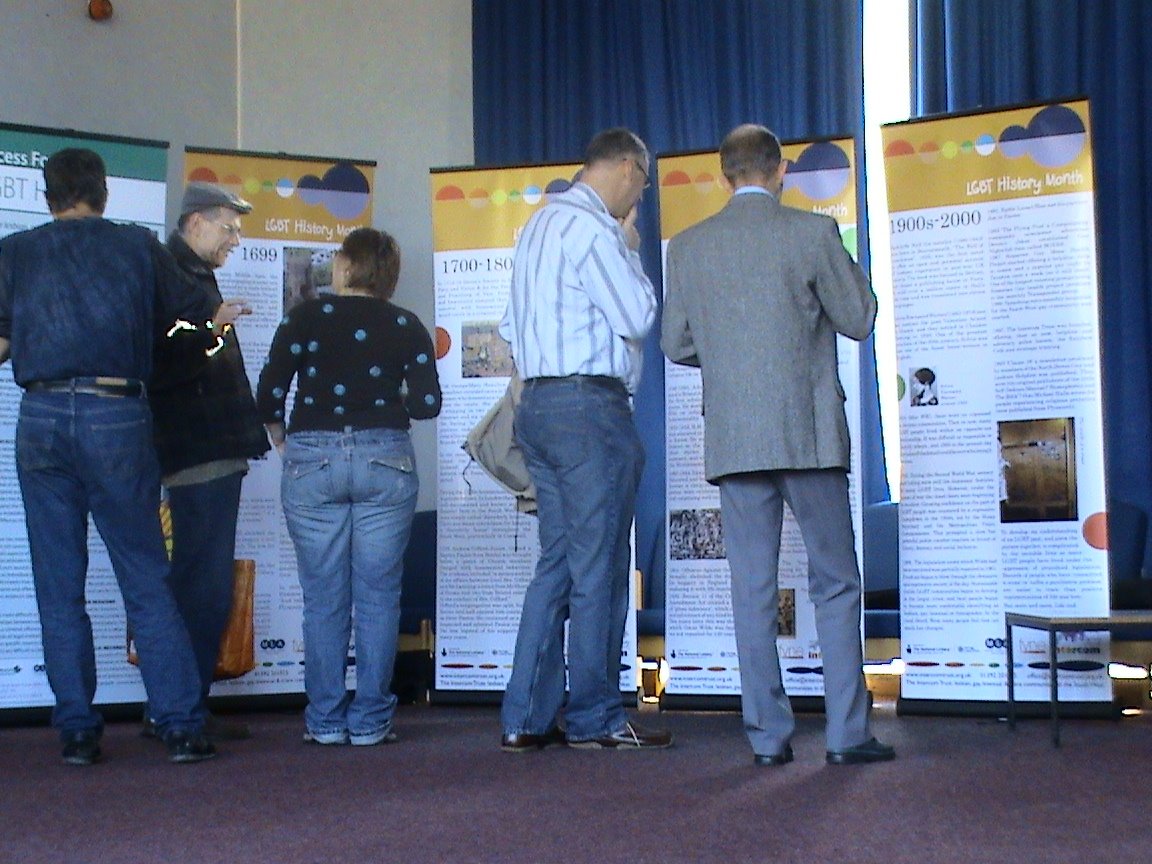
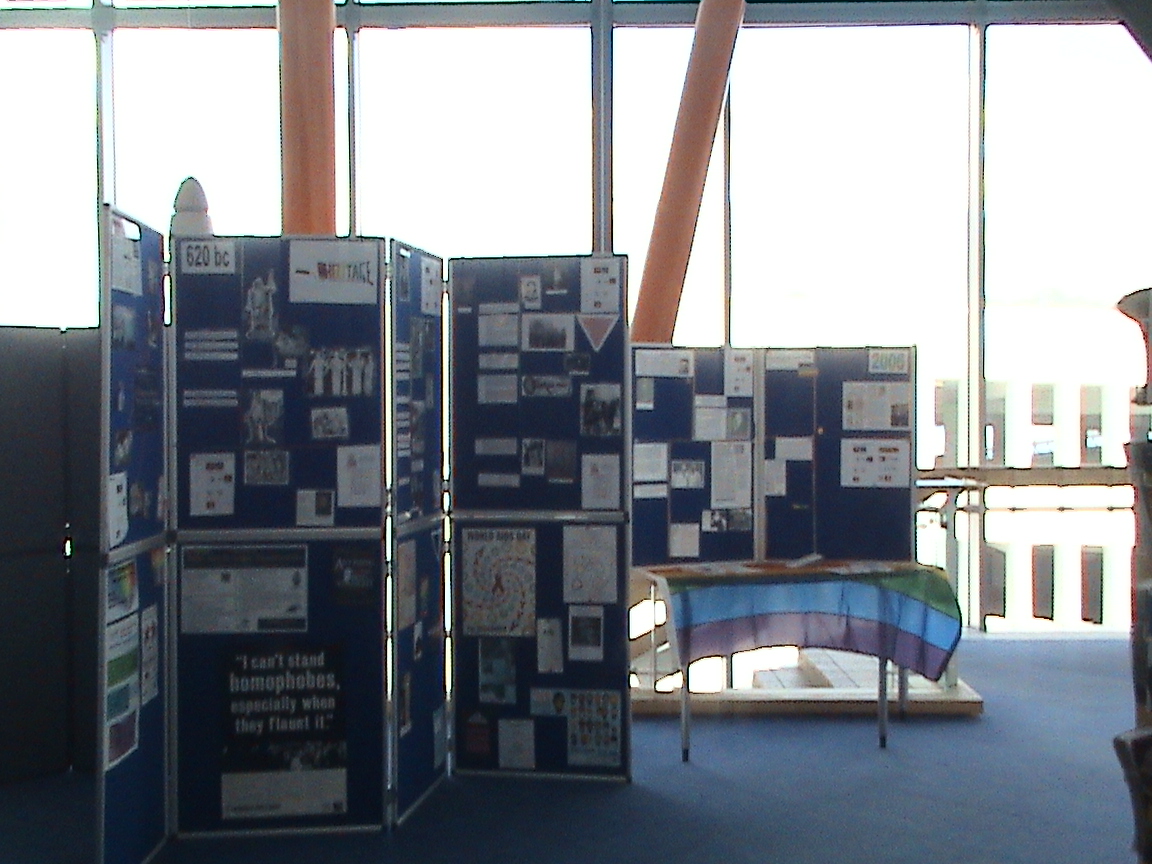
LGBT History month now in its fourth year offers a standard of cultural and historic exposure. Until we can show our cultural and historic roots, be able to unearth the heritage which we know we have and express that through representation and exhibition, we stand the chance of being singled out for criticism and invisibility in the way we have for hundreds of years to come.
The discovery of, and visibility of our histories, will have psychological benefits to many LGB and T people who still feel a sense of isolation and oppression. Our oppression has changed little, with a greater awareness and understanding of our changing identities we offer hope and a cultural foundation on which we can work on to consider our future.
Through the visual representation and celebration of LGBT History we offer a valuable and sustainable method leading, empowering and building cohesive communities. We have a foundation on which to enable LGB and T communities to face real issues; deal with problems and realise aspirations in an effective way. This involves working in partnership with local people and organizations to create a meaningful, shared vision for the future and then making it happen. In our complex and diverse communities this will never be straight forward, however the results can be rewarding.
The Intercom Trust: supporting lesbian gay bisexual & trans people & communities in the South WestRegistered Charity 1072772
Sarah StephensonLGBT Heritage Project Co-ordinator
sarah@intercomtrust.org.uk www.intercomtrust.org.ukPO Box 285 Exeter EX4 3ZT
01392 201015 (Main Office)
07875 183508 (LGBT Heritage Mobile)
01392 20 16 30 fax
Culture wars
Without the earlier subculture of queer politics, gay and lesbian and feminist activists who in the early stages of feminist and sexual politics, built their own networks and communities there would be little to say about LGBT culture.
It was these networks, which were able to respond to the catastrophe of AIDS. With grassroots self help projects, safer sex campaigns, lobbying and fund raising, when HIV/AIDS struck the United kingdom and the western male gay community-to the early indifference of much of the wider society.
There are now more sexual identities and subcultures visible and active in public culture, it is important to remember that alongside popular fascination with gender and sexual diversity, challenges to conservative traditions remain vigorously policed and punished. From epidemic hate crimes against LGB and T people to media fears of the consequences of women’s greater sexual autonomy, and family values which uphold the heterosexual norm.
How is it best to view the culture wars? The apparent rigidity of gender symbolism of the ‘sex act’ remains one of the key factors which can rob women of their personal sexual freedom to choose an identity and autonomy, while at the same time continuing to confirm men’s sexual conformity to masculinity.
Contemporary culture over the last one hundred years has been accompanied by ever greater social acceptance of diversity although this is still seen through the tradition of masculinity and femininity. There has been an expansion in mainstream culture and the promotion of choice as the overriding route to happiness, (in women’s magazines, advice columns, contemporary fiction, film and television). The battle is still open. Funding has been reduced or removed from gay community groups, LGB and T helplines are closing down due to lack of funding, often found previously from health authorities even through HIV infection continues to rise.
Histories
There is a national attempt to recover and rewrite history. The political declaration of an LGB and T identity requires authenticity through reclaiming one’s history.
The Heritage industry seems to create only one version of a twentieth century identity. Putting Lesbian, gay, bisexual and transgender histories at the centre of ‘our’ representation of history we seek to speak for a history and culture which is specific.
We may choose to offer a shared history of our cultural identities which have been and continue to be reflected in a common historical experience and shared cultural codes. (Dress, language, attitudes, etc) which offer us a meaning and identity.
Heterosexuality has been able to, by merely holding back a people’s past, keep a grip on its power and normality. It turns to the past and distorts, disfigures and destroys references to a heritage that goes back millennia. Cultural identity belongs as much to the past as it does to the future; it is a matter of becoming as well as being. We can use this as a step to understanding how ‘we’ have experienced repression and normalization in a heterosexist cultural backdrop.
In order to challenge hostile claims that homosexuality is abnormal or immoral historical experiences of similarities show that being LGB or T is a ‘given’ and has roots in history.
LGBT History month now in its fourth year offers a standard of cultural and historic exposure. Until we can show our cultural and historic roots, be able to unearth the heritage which we know we have and express that through representation and exhibition, we stand the chance of being singled out for criticism and invisibility in the way we have for hundreds of years to come.
The discovery of, and visibility of our histories, will have psychological benefits to many LGB and T people who still feel a sense of isolation and oppression. Our oppression has changed little, with a greater awareness and understanding of our changing identities we offer hope and a cultural foundation on which we can work on to consider our future.
Through the visual representation and celebration of LGBT History we offer a valuable and sustainable method leading, empowering and building cohesive communities. We have a foundation on which to enable LGB and T communities to face real issues; deal with problems and realise aspirations in an effective way. This involves working in partnership with local people and organizations to create a meaningful, shared vision for the future and then making it happen. In our complex and diverse communities this will never be straight forward, however the results can be rewarding.
The Intercom Trust: supporting lesbian gay bisexual & trans people & communities in the South WestRegistered Charity 1072772
Sarah StephensonLGBT Heritage Project Co-ordinator
sarah@intercomtrust.org.uk www.intercomtrust.org.ukPO Box 285 Exeter EX4 3ZT
01392 201015 (Main Office)
07875 183508 (LGBT Heritage Mobile)
01392 20 16 30 fax
Thursday, 20 September 2007
Homophobia is gay: Dykes Motorbikes
This week my son aged 12 came back from school with a badge on.
HOMOPHOBIA IS GAY.
Its not just me I am sure. Who on earth thought that one up?
Ok so there could have been a 'good' heart behind it, really though a backhanded attempt is no attempt at all. To change homophobia in schools is going to have to take a little more thought than that.
Give me strenght!
So I'm going to let you know a little more about me.....
Dykes on Bikes.
Sappho Riders
Lesbians loose on motorbikes.
However you say it bikes are a passion a joy and a cheaper way of getting around.
My new Suzuki SV650 S is practical for motorway travel and general packing in the miles.
My Serrow is joy....she grunts and throbs just how i like it. She goes off road into the woods and mud, she zips down ditches and whizzes up slopes with me, she loves the wet and adores dry, oh! she is the one bike I think I will have to look after in her old age, no rest home for her.
I just love to ride and simple things like, putting my fingers on the throttle and taking an easy but determined grasp of the power that the bike has to offer.
The buffer of wind as I ride.
LGBT History is a passion and riding bikes is a joy.
HOMOPHOBIA IS GAY.
Its not just me I am sure. Who on earth thought that one up?
Ok so there could have been a 'good' heart behind it, really though a backhanded attempt is no attempt at all. To change homophobia in schools is going to have to take a little more thought than that.
Give me strenght!
So I'm going to let you know a little more about me.....
Dykes on Bikes.
Sappho Riders
Lesbians loose on motorbikes.
However you say it bikes are a passion a joy and a cheaper way of getting around.
My new Suzuki SV650 S is practical for motorway travel and general packing in the miles.
My Serrow is joy....she grunts and throbs just how i like it. She goes off road into the woods and mud, she zips down ditches and whizzes up slopes with me, she loves the wet and adores dry, oh! she is the one bike I think I will have to look after in her old age, no rest home for her.
I just love to ride and simple things like, putting my fingers on the throttle and taking an easy but determined grasp of the power that the bike has to offer.
The buffer of wind as I ride.
LGBT History is a passion and riding bikes is a joy.
The Intercom Trust, Heritage project presents;
Painting in the Picture
A hands-on, free, workshop for, lesbian, gay, bisexual
and transgender communities, their families and friends.
Saturday 29 September ExeterSaturday 20 October Taunton
10 A.M. – 4 P.M.
Everyday across the SW Peninsula people are working to conserve and celebrate the stories, places and events of the lesbian, gay, bisexual and transgender people that shaped our communities.
The intercom trust can advise groups, organisations and individuals on identifying, protecting and promoting cultural lgbt heritage.
The fact that so little has been conserved is testament to the invisibility of an otherwise rich, lesbian, gay, bisexual and transgender heritage.
LGBT Heritage brings unparalleled passion and dedication to finding solutions, to discovering and conservation of our ‘uncloseted rarities’. Cultural LGBT Heritage resources will inspire current and future generations.
So don’t miss out!
Visit our website at: http://www.intercomtrust.org.uk
Sarah Stephenson
Heritage Project coordinator
The Intercom Trust
Phone (01392) 678743
sarah@intercomtrust.org.uk
Painting in the Picture
A hands-on, free, workshop for, lesbian, gay, bisexual
and transgender communities, their families and friends.
Saturday 29 September ExeterSaturday 20 October Taunton
10 A.M. – 4 P.M.
Everyday across the SW Peninsula people are working to conserve and celebrate the stories, places and events of the lesbian, gay, bisexual and transgender people that shaped our communities.
The intercom trust can advise groups, organisations and individuals on identifying, protecting and promoting cultural lgbt heritage.
The fact that so little has been conserved is testament to the invisibility of an otherwise rich, lesbian, gay, bisexual and transgender heritage.
LGBT Heritage brings unparalleled passion and dedication to finding solutions, to discovering and conservation of our ‘uncloseted rarities’. Cultural LGBT Heritage resources will inspire current and future generations.
So don’t miss out!
Visit our website at: http://www.intercomtrust.org.uk
Sarah Stephenson
Heritage Project coordinator
The Intercom Trust
Phone (01392) 678743
sarah@intercomtrust.org.uk
Thursday, 6 September 2007
Archive: LGB/T Web pages

Ok! so there you are, you have spent years getting a web site together. What happens if it all goes, or you make changes?
Information is lost.
For lesbian, gay, bi and trans people the web is first point of contact. It offers news advice, guidance, dating, volunteer opportunities, forums, so on and so on, BUT has it always?
When was the first gay web site, the first lesbian web site. When did you first launch your web site and how much has it changed?
It is time to think about archiving web sites.
I know there are hundreds, thousands even, of lesbian, gay, bisexual and transgender web sites here and across the world.
Who is recording and archiving them all?
Try out this site and see just what a nightmare web site archiving is!
OK so how on earth do we archive a web site.
This is the sort of thing that archivist's across the country are having nightmares about.
Two options Print it off, page by page on good quality paper, using good quality ink...........................................or................................................but what about links?
Putting it on a CD ROM or a DVD.
There is a problem with Cd's and DVDs. technology is changing so fast and in so many directions.
Consider when computers where simple machines/basic games consoles, computers would not have been able to read the information on a CD or DVD.
The floppy disk drive has become a recordable medium which is now becoming increasingly hard to open and read.
So what does that leave us with ?
Print the whole lot
There is nothing wrong with putting your wed sites pages on a disc, such as CD or DVD, however do try to print off the most important pages and you wont go far wrong.
You may like to think about archiving on a national archive site. Let me know if you should find a UK based web archive.
Happy archiving!
Wednesday, 5 September 2007
Archiving Photographs lesbian, gay, bisexul and trangender

Archiving and caring for your photographs.
How many photo's have you got in a box under the bed? have you ever thought that they might be of interest to someone who is researching a subject, culture, people or event?
No! well now is the time.
So what might you have?
There is the general photograph and negative.
Polaroids
Slides
And that old dusty black and white from before the digital age.
All of these photos are worth conceiving. Over time they will show a significant heritage both for you and your family and for wider communities.
So what do we do to help them last the tests of time?
Photographs, negatives and slides all want to be kept in cool dark places with good ventilation.
Is the attic or the cellar a good place?
No not really. If it is the best you can do then just keep them from the walls and areas where damp could reach them.
A room that doesn't get to hot or cold away from walls which can become damp etc.
Always always whenever you are doing anything in the line of archiving, WASH YOUR HANDS!
Avoid wherever possible using anything other than soft pencils on your photos.
Avoid at all times photo albums that have sticky surfaces.
Try to avoid cellotape, staples, paper clips or rubber bands.
If you are going to use a photograph try if you can to photocopy it. It preserves the original and allows you to make mistakes which will not damage the originals.
Enjoy your pix and let me know what you have in a shoe box. Photo's of gay prides maybe, first girlfriend or picture of a women's room?
Friday, 31 August 2007
Archives of paper based material: Lesbian and Gay memoribilia

Well Archivists here's a basic how too and how not too.
I will look at different types of material over the coming five days.
Today it is Paper!
First Rule of acrhiving paper based material:
Check there condition.
Keep them out of the light, heat or extreme cold.
Keep in acid free folders.
Do not attempt to repair damages. ( seek the advice of an experienced archivist).
Paper based archives;
Do keep everything you have ever written, diaries, poems, letters you never sent, letters people have sent you. Flyer's, posters, organisational documents all of it.
Even think about keeping that napkin you scribbled on!
Now once you have all this paper based information don't go touching it all over with sticky hands. WASH THEM.
Oh! and when you are looking at letters you have DON'T throw the envelope away. it is dated and will hold a record of where it was sent and too who and when (most important). Unfold any letters you have and keep them flat. If you are really keen that they last then pop them into acid free folders.
If you have a heap of newspaper cuttings. Best thing you can do is photocopy them on too acid free paper. News papers will be a disaster after a short period of time. Cheap paper will not last long.
Local newsletters, women's centre newsletters, gay and lesbian locally produced lewsletters are all well worth preserving.
If you are holding paper together, use brass paper clips, they are better than Staples.
First Rule of acrhiving paper based material:
Check there condition.
Keep them out of the light, heat or extreme cold.
Keep in acid free folders.
Do not attempt to repair damages. ( seek the advice of an experienced archivist).
Paper based archives;
Do keep everything you have ever written, diaries, poems, letters you never sent, letters people have sent you. Flyer's, posters, organisational documents all of it.
Even think about keeping that napkin you scribbled on!
Now once you have all this paper based information don't go touching it all over with sticky hands. WASH THEM.
Oh! and when you are looking at letters you have DON'T throw the envelope away. it is dated and will hold a record of where it was sent and too who and when (most important). Unfold any letters you have and keep them flat. If you are really keen that they last then pop them into acid free folders.
If you have a heap of newspaper cuttings. Best thing you can do is photocopy them on too acid free paper. News papers will be a disaster after a short period of time. Cheap paper will not last long.
Local newsletters, women's centre newsletters, gay and lesbian locally produced lewsletters are all well worth preserving.
If you are holding paper together, use brass paper clips, they are better than Staples.
Subscribe to:
Posts (Atom)